VoloPort Concept - Modular eVTOL Vertiport - Departure and Arrival Facility for Air Taxis and Drones


About Graft


ProjectVoloPort
ArchitectsGraft
Project partnersGeorg Schmidthals, Lars Krückeberg, Wolfram Putz, Thomas Willemeit
Project leadSebastian Massmann
Design leadMarta Piaseczynska
Project teamJulia Korpacka, Tatiana Lebedeva
Year2021: Commission for VoloPort together with Arup and Bayards Aluminium Constructies
2019: First prototype built in Singapore by GRAFT Brandlab
2018: Competition, 1st prize, together with GRAFT Brandlab and Arup


Description by designers

The German eVTOL design company Volocopter is a pioneer of Urban Air Mobility and develops fully electric vertical take-off aircraft as a mobility solution for use in urban areas. As a hub for the Volocopter aircraft, the VoloPort vertiport was devised by GRAFT in collaboration with Volocopter, Arup and Bayards Aluminium Constructies.

The VoloPort is part of the Volocopter modular urban air mobility infrastructure network and acts as a gateway within the public realm. Suited to the constraints of densely populated areas, its compact, modular and expandable design can be employed in a variety of inner-city locations – either on the ground, on the roof of a high-rise building or on a floating, water-based platform.

Advertisement

Stack Modular Housing - Prefab Affordable Housing, Manhattan, New York


Floor plans / Drawings
Construction Process
Location and contact info
About GLUCK+


ProjectThe Stack Modular Housing
ArchitectsGLUCK+
Design TeamShannon Bambenek, Jacob Chartoff, Marc Gee, Peter L. Gluck, Thomas Gluck, Charlie Kaplan, James Macgillivray, Brian Novello, Silan Yip
Area37,710 square feet
Structural EngineersSilman (Foundations), The Harman Group (Modular)
Geotechnical EngineersPillori Associates
Mechanical EngineerRodkin Cardinale Consulting Engineers
Prefabrication ConsultantDeluxe Building Systems Inc.
LocationManhattan, New York, USA
PhotographyAmy Barkow
Year2014


Utilizing an off-site construction method and an innovative design strategy, The Stack modular housing has managed to streamline the entire development process and create a high-quality product with a small carbon footprint, pioneering the future of construction in New York City.

Individual modules are constructed and fully finished in a factory setting, while the eventual building site is simultaneously prepped for their arrival. Expending far fewer raw materials than traditional construction methods, the modules are fabricated in a highly controlled environment, allowing for quality assurance and precise engineering.

Once transported and on-site, the modules are literally stacked—the inspiration behind the building's name—and seamlessly integrated into a singular structure, an aesthetically pleasing building that enhances both the streetscape and the pedestrian experience. In the final stage, an expressive façade is fixed to the modular framework, making a strong visual statement to passersby that reflects the building's unique means to existence.

The modular construction method rapidly accelerates the production schedule, completing buildings in virtually half the time of the traditional on-site process, while also opening a new realm of opportunity for urban development. With its distinctive architecture and luxurious yet accessible lifestyle offering, The Stack modular housing serves as a proud example of the possibilities enabled by modular construction, and is a welcome addition to the Inwood community.

Advertisement

The Monetary and Non-Monetary Impacts of Prefabrication on Construction: The Effects of Product Modularity

April 2022

https://doi.org/10.3390/buildings12040459

Krishna Chauhan1, Antti Peltokorpi1, Rita Lavikka2 and Olli Seppänen1

1Department of Civil Engineering, Aalto University, 02150 Espoo, Finland

 2VTT Technical Research Centre of Finland, 02044 Espoo, Finland

1. Introduction
2. Theoretical Background
3. Method
4. Analysis and Results
5. Discussion
6. Conclusions


Abstract


Prefabrication is rapidly increasing in construction, and previous research has identified various impacts of prefabrication on projects. Modular product architecture is a great enabler for prefabrication; however, practitioners would benefit from more explicit knowledge on the impacts of prefabricated product types with different levels of product modularity. This study investigates the connection between the modularity level and the monetary and non-monetary impacts of prefabricated products. First, the literature on prefabrication and modularity is used to form three propositions which are related to product modularity and the benefits of prefabrication. The level of modularity is considered with two dimensions: the proportion of modules and the module description detail. Second, four prefabricated products are analyzed to test the propositions. The analysis revealed that (1) the level of modularity adopted in the product is directly proportional to the benefits. More specifically, (2) a higher proportion of modules in a project product contributes to higher cost-benefits. On the other hand, (3) prefabricated products with highly detailed module descriptions seem to lead to higher non-monetary benefits, such as better ergonomics and work satisfaction. The study reveals new empirical evidence on the relationship between product modularity and the benefits of prefabricated products. Cost-benefit analysis revealed that even though some prefabricated products could have higher direct costs, the total cost can still be lower than conventional construction when also considering the indirect benefits. Practitioners can utilize the findings when selecting modular and prefabricated products that best fulfil their project objectives.

First LEED Silver Certified Prefab Modular Home in Colorado, Denver


Floor plans
Manufacturing in factory
On-site Assembly
About Tomecek Studio

Awards
LEED Certified, LEED-Home Pilot Program
2008 Builder Magazine Grand Award
AIA Colorado Citation Award
AIA Colorado North Chapter Merit Award
AIA Colorado YAAG Built Architecture Award


Project32nd Modular
ArchitectsTomecek Studio
Area2,750 square feet
Manufacturing time (80% completed in factory)3 weeks
Assembly time4,5 hours
Project completion time4,5 month
LocationDenver, Colorado
Year2007


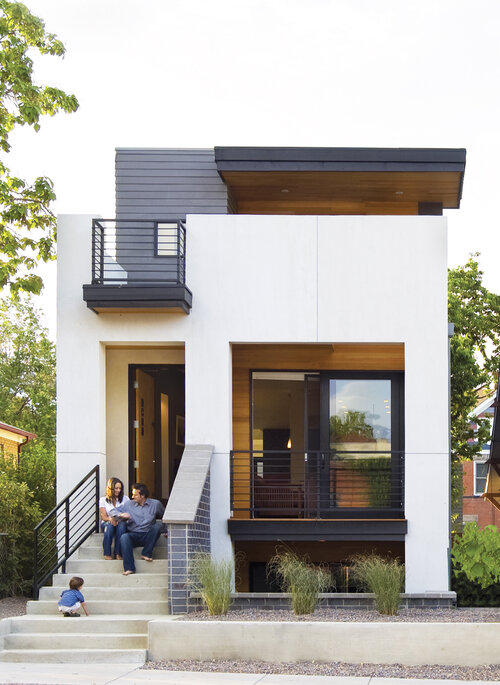
When Brad Tomecek and his family outgrew their Denver loft and decided to swap it for a single-family home, the architect took the opportunity to experiment with an alternative building technique.

He purchased a narrow 25-foot-by-125-foot infill lot within walking distance to downtown, and, along with his colleagues at Studio H:T, designed a 2,750-square-foot modular house to be built in a factory. “It was an experiment to bring modern green design through the prefab process,” says Tomacek. “It saves time and reduces material waste to just 5 percent.”

The first LEED Silver–certified modular house in the state, it has a poured-in-place foundation with two boxes stacked above. “Because the site borders a commercial area, the zoning let us go a little higher than usual,” Tomacek explains. “That allowed for three stories including a basement.” Sliding the top box back a few feet created an upper southern deck and a covered rear entry area.

The project took just four-and-a-half months from start to finish. “We went from a foundation to a full frame structure in about five hours,” says Tomecek. “It was a good experience, and now we have another tool in our toolbox.”

Prefab Inflatable Home + 3D Printed Shell by Hassell, Mars


Schemes
Video
About Hassell
About Eckersley O’Callaghan


DesignHassell
ClientNASA
Design TeamXavier De Kestelier, Jonathan Irawan, Shawn Wu, Xuanzhi Huang, Nikolaos Argyros, David Brown
Structural EngineeringEckersley O’Callaghan
LocationMars
Project Year2018


Hassell sets out to design the perfect habitat (prefab inflatable home under 3D printed shell ) for space explorers on the red planet as part of NASA’s international 3D Printed Habitat Challenge.

Hassell team, in collaboration with structural engineers Eckersley O’Callaghan (EOC), was shortlisted to design the world’s first human home on Mars. In Hassell design, an external shell made from local Martian regolith would be built in advance by autonomous robots before exploration teams arrived to construct the interior – a series of prefab inflatable ​‘pods’ containing everything for work and life on Mars.

Hassell aim was to bring a more human element to space design, typically all about maximum efficiency and performance. Hassell habitat - prefab inflatable home and 3D printed shell goes far beyond just ticking the boxes for safety and survival. It’s a home away from home where astronauts can carry out the most important work in the history of space exploration.

Hassell and EOC were shortlisted as a top 10 entry in the challenge.

Another way of living: The Prefabrication and modularity toward circularity in the architecture

2020

https://doi.org/10.1088/1755-1315/588/4/042048

Marielle Ferreira Silva 1

1 Faculty of Humanities, Education and Social Sciences, University of Luxembourg, Luxembourg

marielle.silva@uni.lu

1. Introduction
2. Methodology
3. Modular and Prefabricated Architecture
4. Slab design process and Discussions
5. Conclusion


Abstract.


The world requires housing capable of addressing the ecological challenge and social changes. Various architecture projects have used alternatives to solve these problems, like housing complexes to increase density, fast and low-cost constructions with prefabricated and modular methods and materials. The concrete will always be rooted in the culture of architecture, even the industry of construction can work with other materials and whose manufacture produces a considerable amount of CO2. Taking into account the different construction cycles and the evolution of uses and users, a change in architectural culture is required. This paper aims to shows that it is possible to achieve the concept of circularity in the built environment through the architectural design process. The research by design methodology was used to develop the recyclable typology named Slab focused on residential prefabrication methods, which will facilitate their disassembly and recycling. As a result, the design process and the models' evolution of the Slab prototypes are presented in this paper. Prioritizing prefabrication and the modularity within the architectural design process has advantages, such highly effective reduce footprint areas, large-scale infrastructure for flexible use, and individual housing units with communal activities, besides, assure the building conditions for future disassembly and recycle.

$50.000 Elon Musk’s Small Prefab Home, Boca Chica, Texas


Floor Plan
About Boxabl


Order Here

What do Elon Musk and prefab homes have in common? For now at least, a prefab house called Boxabl is Musk’s abode, which, rumor has it, he lives in near SpaceX ground zero in Boca Chica, Texas after selling off nearly all of his real estate holdings.

The 20x20 small prefab home might be commonly known as an accessory dwelling unit (ADU) or perhaps a guest house, but in the Boxabl world, it’s referred to as Casita. Unlike other small prefab houses, Boxabls have a unique, flat-pack design that allows them to break down to 8.5 feet in width and be delivered onsite via truck, train, air or ship.

The main materials in the prefab home are steel, concrete and EPS foam, specifically chosen for their durability. They don’t degrade like other building materials, so the structures are built to last a lifetime. Not only are Boxabls rated for hurricane-strength winds, but because there isn’t any wood or sheetrock that could be damaged by water, the prefab homes won’t grow mold or deteriorate due to moisture from floods.

In addition, the company said, “Nothing is fireproof. But Boxabl was engineered with fire resistance in mind. The interior and exterior of the structure is clad with non-combustible materials. We think this means flying embers that spread forest fires won’t ignite your Boxabl.”


There are several costs involved in getting a Boxabl set up, including the Casita itself, starting around $50,000. From there, you’ll need land, a foundation and utilities to plug into. You’ll also pay a delivery fee, but the company can hook you up with certified builders to unfold the Boxable for you in your desired location, which takes less than a day. However, the building will save you money in the long run, because it is extremely energy-efficient. Each tiny home relies on a small air conditioning system as needed and has high R value insulation, a tight building envelope and limited thermal bridging to keep the space fairly temperature controlled.

The small prefab home comes wired and plumbed, so it’s ready to accept solar power or any other energy source the buyer chooses. The prefabricated design, complete with nearly everything you need to open the door and move in (including a full-size refrigerator, stove, dishwasher and washer/dryer) is also seen as an option for temporary shelters that can be preloaded with supplies and delivered quickly for emergency response. Currently, there are no customization options, and the company is only taking orders while it completes a manufacturing plant.

You can order small prefab home like that on the Boxable website here

Prefab Modular Houses by A-cero, Spain


Prefabricated Material for Modular House


Prefabricated Material for Modular House

https://doi.org/10.1088/1757-899X/662/4/042020

C Dharmawan1, M Alviano2*

1 Fakultas Desain, Universitas Komputer Indonesia,Indonesia
2 Fakultas Teknik dan Ilmu Komputer, Universitas Komputer Indonesia, Indonesia

* Email: muhammadalviano@mahasiswa.unikom.ac.id

Abstract. 

This research identifies prefabricated materials which aim to save time and cost of
making a modular house. The purpose of this study is to provide the best solution for the entire
Indonesian population especially to the government and entrepreneurs who have a project
about housing that there is an appropriate solution to reduce development costs, reduce
development time and reduce the inefficiency of a typical residential house which is certainly
more expensive than modular. Modular housing has a unique system and is certainly fast in the
development process, usually a technology that is paid at a high price, but innovation is not
always expensive. There are various types of modular home systems, but not all systems are
compatible or compatible with climate conditions in Indonesia, but most modular systems are
widely used in Indonesia. This research used descriptive analysis methods to explain the
people growth in Indonesia, that increasingly very fast, so they need more house very fast too,
and the next stage is to explain the prefabrication of materials that are appropriate to the
climate in Indonesia. Besides, this study aims to obtain information on the types of prefabricated
materials that can be used in the manufacture of modular houses and specifications
from pre-fabricated. The results of this study explain that there is a prefabricated material
module system in the form of single and double modules which are used in making modular
houses, depending on the size and type of house. Therefore, this research is useful for architect
and developer in choosing modular materials.


Prefab Airbnb in Pioneertown - 2 Bedroom Prefab Home, California


2 Bedroom Prefab Home Floor plan
About Cover


BuilderCover
Bedrooms2
Bathrooms2
LocationPioneertown, California

Thoughtfully inserted into the desert landscape, a low-impact, 2 bedroom prefab home in California embraces the outdoors in minimalist style.

It was love at first sight for Los Angeles – based writer Leslie Longworth when a friend introduced her to a five-acre lot for sale in Pioneertown, a tiny historic community in Southern California. Surrounded by mountains and otherworldly views of Joshua Tree National Park — and with only a dirt road for access — the remote property was the perfect place for a writer’s retreat.

Intent on preserving the pristine environment as much as possible, Leslie turned away from traditional site building and started researching prefabricated housing as a low-impact alternative. She came across the Los Angeles prefab startup Cover, and although the company had yet to complete their first build at the time, "everything clicked" from the moment she spoke to founder Alexis Rivas.

Spurred by her enthusiasm and vision, the startup made a special exception for Leslie—it usually focuses solely on accessory structures in Los Angeles—and designed and built a two-bedroom, two-bath house in the desert two-and-a-half hours away from the city.

"Once Alexis agreed to come to the desert, I felt confident the land would captivate him…and it did," says Leslie. "The Mojave has a magnetism unlike anywhere I’ve ever been, and our land—which we feel wildly blessed to be the stewards of—has its own powerful vibration and magic. I think he said yes in the first five minutes of being there."

The happy partnership also gave Cover the opportunity to prove the capabilities of their fully integrated panelized building system in a standalone primary house—as well as their system’s performance in a harsh desert landscape.

As a provider of turnkey designs, Cover created a completely custom 2 bedroom prefab house and took care of the permitting, manufacturing, site work, and installation. The 2 bedroom prefab home was delivered complete with fixtures, finishes, Wolf Sub-Zero appliances, and a state-of-the-art radiant heating and cooling system.

The project took about two years to complete, with the majority of the time spent preparing the foundation and utility work—which included connecting the home to the power grid with a new underground service line, drilling a new well for water, and installing a waste management system with a septic tank and leech fields. The manufacture of the panels, which were built in Cover’s factory, and on-site assembly took only six months to complete.

"Designing around the endangered Joshua trees, boulders, and the view was extremely difficult," says Thomas Heyer, lead designer at Cover. "We were able to overcome it through a combination of more rigorous 3D mapping using drone imagery and handheld photos, and by leveraging our panelized building system to modify the design of the home to integrate with the property."

Floor-to-ceiling, low-e windows with automatic integrated shades blur the line between indoors and out and "maximize the potential for awe" of the landscape, per Longworth’s request. In addition to the use of hydronic heating and cooling, the home further reduces its energy footprint with low-e windows, low-flow fixtures, and passive solar orientation that shields the interiors from the harsh desert sun. Longworth plans to add solar panels to her home in the future.

"We are particularly happy with how the floor-to-ceiling windows frame the boulders, especially in the master bathroom," adds Heyer. "The goal of the project was always to use the proximity of the large rocks and elicit a sense of continuity by framing them in the various rooms." - Dwell


Description from Airbnb

Sol to Soul is a luminous, all-white, architectural 2 bedroom prefab home, California, on five-acres in the Gamma Gulch of Pioneertown, fifteen minutes from the famous Pappy + Harriet’s. It’s a seven-minute drive off the pavement of Pipes Canyon Road down a private, well-maintained dirt road. You will pass fields of Joshua Trees -- far as the eye can see -- as well as some of the more beautiful architectural houses in the desert.

Sol to Soul 2 bedroom prefab home, California is high design in the wild desert, a retreat with every amenity for your heart, soul and comfort, surrounded by boulders that are millions of years old, all in harmony with the hawks, lizards, birds and bunnies, as well as the sun, stars and the Milky Way which appears over the house every night.

If ever there was a place tap into what you’re needing or desiring, it’s here. Do as little or as much as you feel moved to… even if you never leave the 5-acre grounds, you will leave recharged with the magic of this very special place. You are surrounded by thousands of boulders, some so large they will fill you with awe.

At Sol to Soul, you can easily spend the entire day just being – watching the sun rise, the clouds drift and the sun set (we’ve done it, it’s awesome). The interior of this 2 bedroom prefab home, California, is warm and elegant. The artwork has been curated from my favorite local and Venice artists. The furniture is predominantly European-designed – from Moroso to Christian Liagre – and has the softest, vintage Moroccan rugs throughout the house. For privacy, there are no windows facing the “street”. But every room has a floor-to-ceiling slider with magical views of the boulders and sky, and a deck to transition you into the wild (except for the bathrooms).

The bedrooms feature king-sized beds with My Green Mattress brand pure Dunlop Latex mattresses and pillow tops (all-natural from trees, no chemicals or metal coils); Egyptian cotton and linen bedding; floor-to-ceiling sliders so that you may sleep with a view of the moon and stars – or black-out curtains if you prefer.

Tucked into the shelter of a giant boulder, there is a deck with a top-of-the-line Hot Springs saltwater hot tub, outdoor shower and cozy seating area with some of the most amazing views at Sol to Soul. There are sun loungers on the master bedroom deck.

On the deck off the kitchen/living room, there is an outdoor sofa, lounge chairs and fire pit, in addition to a teak-dining table with seating for six. There is another teak dining table inside, also with seating for six. These two tables could be combined to entertain larger parties.

This 2 bedroom prefab home in California is equipped with a state-of-the-art radiant heating and A/C system; Wifi; built-in fire sprinkler system; and smoke and carbon monoxide detectors.


During your stay you may see lizards, cottontail rabbits, jackrabbits, coyote, hawks, bobcats, crows, families of quail, chipmunks, and myriad bird species.

Whatever you are moved to do or not do, let go of or allow to come in while you are here, we wish you a beautiful, enlightening, joyful, magical, transformative and memorable stay at Sol to Soul… where we welcome you to dream, play, burn, be and love.